Solving Recurring Casting Belt Failures
with Laser Welding:
Increasing Average Operating Life by 45%
Recurring weld failures were disrupting a manufacturer’s continuous casting operation. Belts were cracking at their welded joints in the heat affected zone, causing premature failures, unplanned shutdowns and additional maintenance. The manufacturer approached Laser Additive Solutions (LAS) to improve belt reliability and extend operating life.
The challenge extended beyond making the belts last longer. The existing TIG and GI welding processes had proved sensitive to changes in operator experience, resulting in substantial variation in belt life which made it difficult to plan which alloys to cast. The customer needed a dependable and predictable welded joint that would support more predictable production.
The material to be welded was Stainless Steel 310S with a thickness of 2.5mm, width of 80mm, a welded joint length of 113mm at 45° and a belt length of 14.2m.
In operation the belts are tensioned with a series of pulleys and continuously cast aluminium is then rolled between the belt and roller to achieve the desired dimensions.
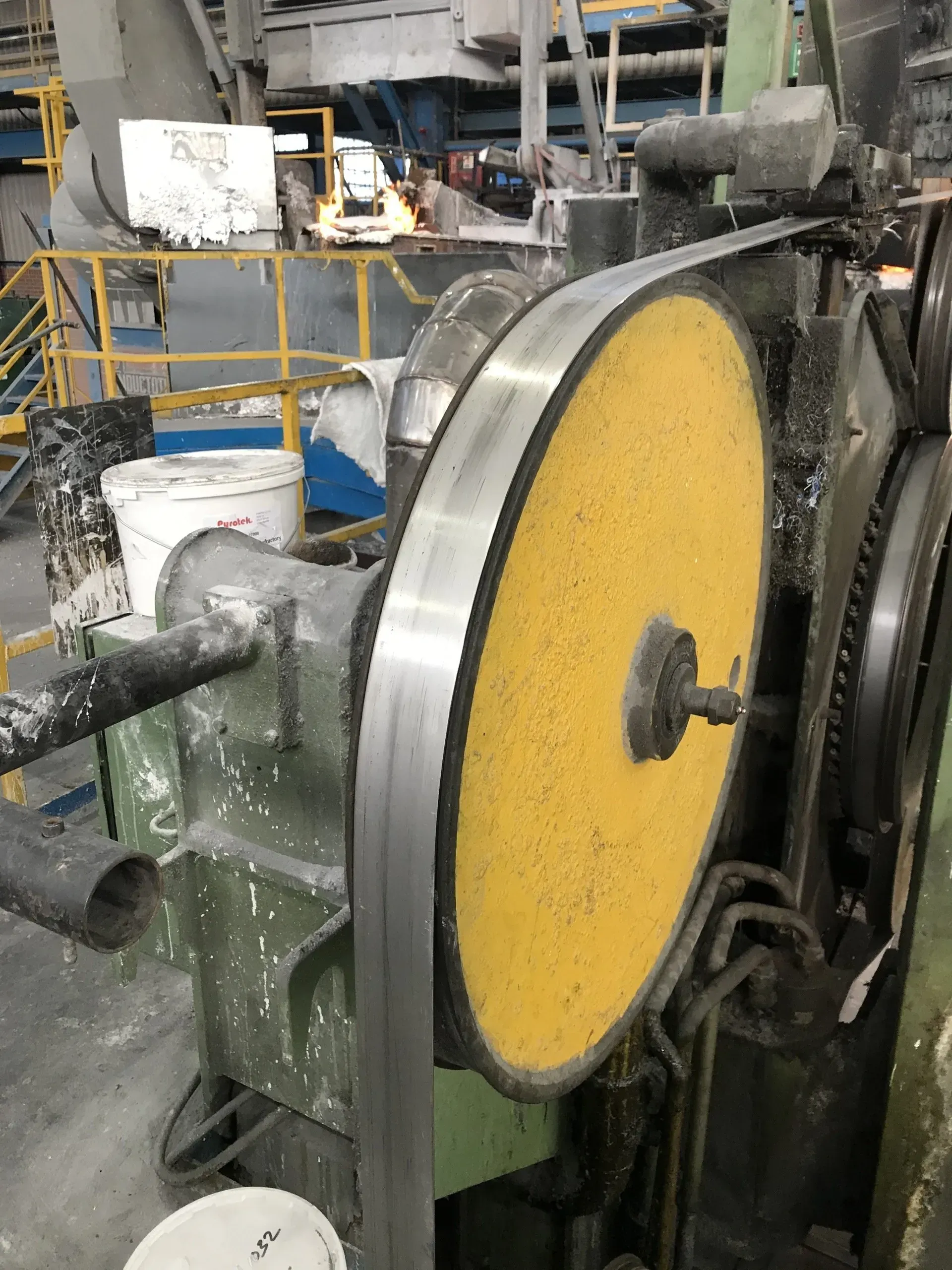
The belt operates under severe thermomechanical conditions, with one surface in direct contact with molten aluminium at approximately 700°C while the opposite surface is actively water-cooled. This creates a steep temperature gradient through the belt thickness, combined with continuous tensile loading and constant motion. The welded joint must withstand these simultaneous thermal and mechanical demands while maintaining its integrity throughout sustained casting operations.
LAS discussed with the customer about their belt failures and it was determined that they always failed at the heat affected zone of the weld with cracks propagating from the outside edge of the belt inwards. The size of the heat affected zone was particularly sensitive to manual welding operator experience and their ability to minimise heat input.
LAS evaluated the application and introduced an automated laser welding approach to replace TIG and GI welding at the belt joints. The aim was to use a precise, lower heat-input process to limit thermal distortion, improve weld consistency and critically reduce the size of the heat affected zone. The joint profile was at a 45° angle to discourage cracking perpendicular across the belt width and make the joint fit-up easier to achieve with clamping.
Why choose Laser Welding over conventional TIG?
Automated laser welding was selected for this application due to its repeatability, removal of operator skill as a factor and critically its low heat input as the heat affected zone of the weld is where failure occurs.
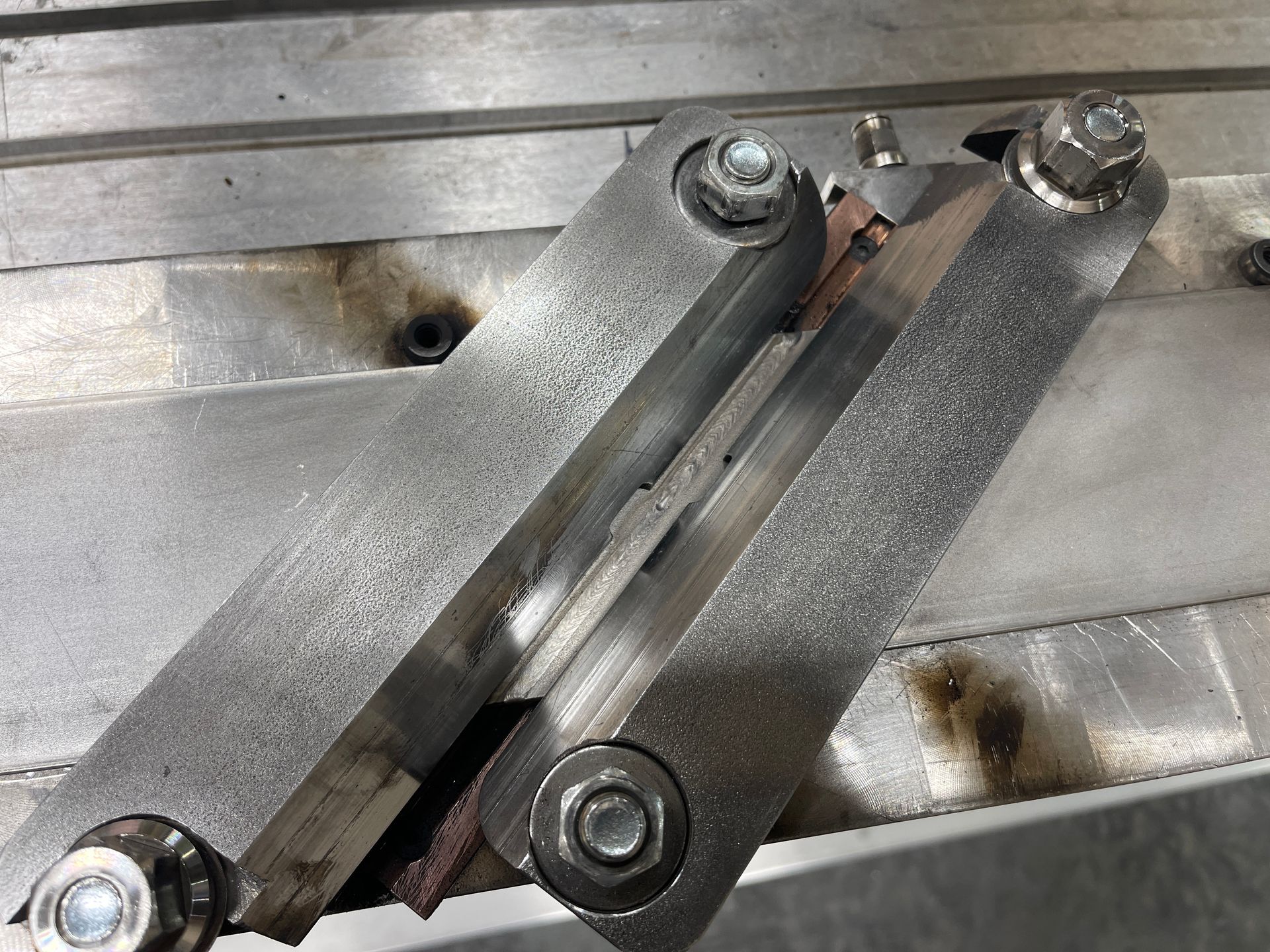
The joint was prepared with a saw set-up at a 45-degree angle, fit up control of the two joins was controlled with a bespoke designed and manufactured fixture.
Parameters were developed by performing a design of experiment varying multiple welding parameters such as laser power, scan speed and shielding gas flowrate onto sample pieces. These samples were then sectioned and metallurgical analysis performed with the highest quality parameter set chosen. A weld procedure was then created to capture key information regarding the set-up and welding parameters for machine operators to follow.
For a manual welding process it was standard practice to weld run off tabs onto the belt material at either end of the weld, we started with this method but realised it wasn’t practical for automated laser welding so instead opted for improved clamping and welding the belt material from outside to in from both ends.
To control the geometry and quality of the root of the weld a channel was built into the fixture with argon delivered to it thereby supporting the weld underneath.
The laser-welded belts were evaluated in the customer’s production environment. Feedback recorded their operating life and whether cracking was present when they were removed. Phases 1 through to 6 were a combination of parameter development and then practical set-up improvements. Phase 7 group of LAS belts represented the first group of 11 belts to be put through the customer’s production environment, providing a reference point for the performance improvement.
Challenges Overcome
LAS encountered a challenge unreeling the coils of SS310S material so developed an in-house unreeling fixture which made dispensing far safer. We also recognised a need for under weld shielding so incorporated that into our fixture design. We considered the shape of the nozzle for the fixture design, so clamps were chamfered at 45° to enable complete access to the weld joint while still providing sufficient clamping next to the joint for an optimal fit-up.
Comparison of Automated Laser Welding compared to Manual TIG and GI
LAS' laser welded belts entered production just 3 months after first contact with us. Below is the comparison of laser welded belts compared to TIG belts.
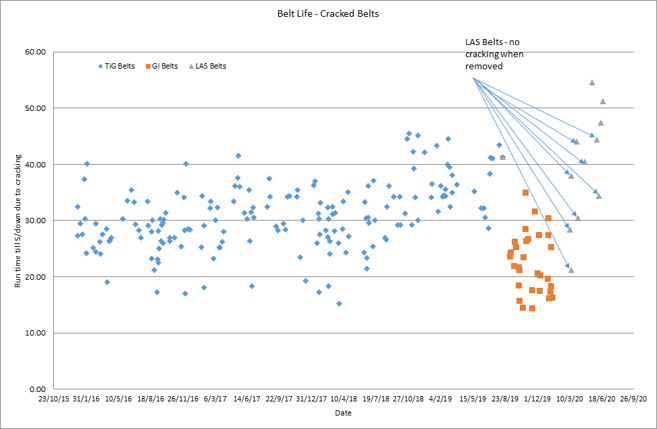
The phase 7 LAS belts that ran to failure achieved an average operating life of 51.32 hours, compared with the customer’s previous best TIG-welded average of 35.40 hours. This represents an increase of 15.92 hours—approximately 45%.
Other LAS belts were removed because production stopped for unrelated reasons and showed no signs of cracking. Their recorded operating hours therefore did not represent their full service life, and should be distinguished from the belts that ran to failure.
For the customer, longer belt life offered a direct operational benefit. Based on its shift pattern at the time, the customer estimated that the improvement would mean one fewer shutdown per week, delivering an annual business benefit of approximately £125,000 in its 2020 assessment. The customer also identified benefits relating to production planning, process stability, product quality and health and safety. Subsequent production confirmed this estimate and the belts proved to be more predictable in their lifespan allowing operations to plan more easily any shutdowns.
Customer Testimonial
“Laser Additive Solutions have provided an exceptional service through the project we ran on improving the time-to-failure of one of our critical components.
The work done on our continuous caster belt component has increased our productivity and profitability whilst improving safety and AMG Aluminium UK’s ability to schedule material for “just in time” manufacture.
From project inception through development work to finished components and product approval, in all aspects LAS have provided 1st class technical expertise and an understanding of the need to deliver results in a timely manner".
Gavin Spray, Technical Support Engineer (AMG Aluminium UK)
This project demonstrates how a change in joining process can address a recurring production problem and deliver measurable improvements in component life. By connecting welding performance with the customer’s operating requirements, LAS helped create a more reliable basis for continuous casting.
Facing recurring component failures or inconsistent weld performance? Speak to LAS about your application and the improvement you need to achieve.